Expanded polystyrene (EPS, known in Polish construction as styropian) is the dominant insulation material in the ETICS external wall insulation system in Poland. Its combination of low thermal conductivity, light weight, workability, and relatively low cost has made it the standard choice for both new-build external walls and retrofitting of existing buildings. Understanding how EPS performs in ETICS applications requires examining not only the material's declared thermal conductivity but also the system as a whole, fire considerations, and Polish regulatory requirements.
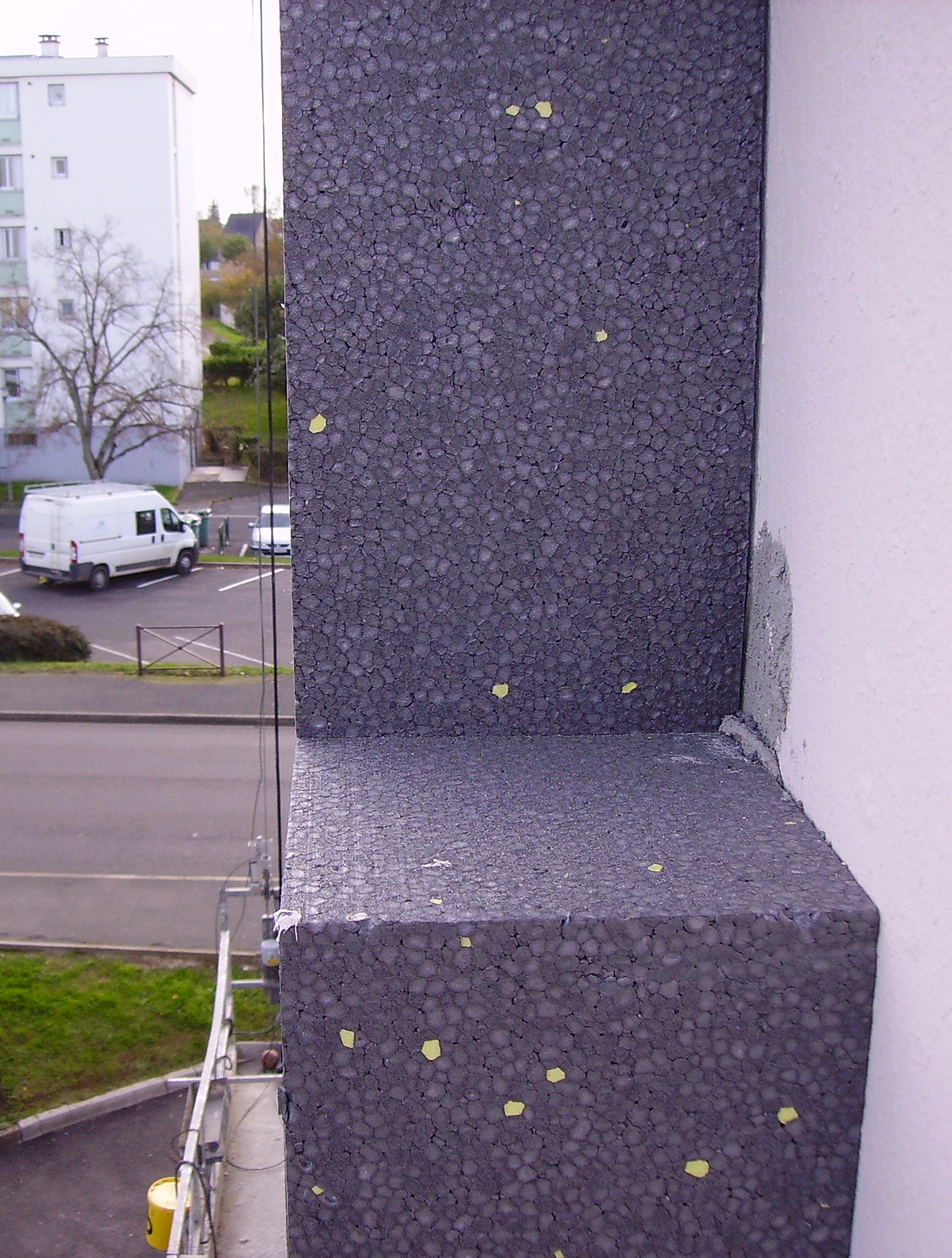
EPS polystyrene boards being applied to a building facade. Source: Wikimedia Commons, CC BY-SA.
What ETICS Is
ETICS (External Thermal Composite Insulation System) — referred to in Polish as "system ociepleń metodą lekką mokrą" or simply ETICS — consists of an insulation layer bonded and mechanically fixed to the external wall substrate, covered with a reinforced base coat, and finished with thin-coat render. The system is specified as a complete package: adhesive mortar, EPS boards, anchors, base coat, mesh, primer, and render are supplied and certified together by the system manufacturer.
Polish practice follows European Technical Assessments (ETAs) issued for ETICS under EAD 040083-00-0404, replacing the older ETAG 004 guideline. The system manufacturer holds the ETA and takes responsibility for the combination of components. This is a key regulatory distinction: substituting individual components from different manufacturers within a certified system invalidates the certification.
EPS Product Types in ETICS
Not all EPS grades are interchangeable in ETICS applications. The most relevant parameters are:
- Declared thermal conductivity (λD) — standard white EPS is typically 0.031–0.040 W/(m·K). Graphite-enhanced grey EPS (often marketed under trade names) achieves 0.030–0.033 W/(m·K) for the same density range.
- Compressive stress at 10% deformation (CS) — CS(10)60, CS(10)80, CS(10)100, CS(10)150 kPa variants are available; facade applications typically use CS(10)60 or CS(10)80.
- Dimensional stability — boards must be stored and allowed to stabilise in temperature before installation; freshly manufactured boards can continue to shrink for several weeks.
EPS declared lambda comparison (EN 13163)
| EPS type | λD W/(m·K) | Thickness for U=0.20 W/(m²K)* |
|---|---|---|
| Standard white EPS | 0.038 | ~180 mm |
| Standard white EPS, low λ | 0.033 | ~160 mm |
| Graphite EPS (grey) | 0.031 | ~150 mm |
* Approximate, assuming 250mm reinforced concrete wall and interior plaster. Actual calculation per PN-EN ISO 6946.
Fire Behaviour of EPS in Facades
EPS is a combustible material. Standard EPS products with flame-retardant additive (FR grade, obligatory for construction use in Poland) achieve Euroclass E under EN 13501-1 when tested independently. However, within a certified ETICS system, the complete system is tested and may achieve a better classification through the protective effect of the render layers. Polish regulations and European guidance documents set specific rules for when non-combustible insulation is required in facade systems.
Firebreaks
In Poland, ETICS systems using EPS above certain building heights must incorporate horizontal and vertical non-combustible firebreaks (opaski ogniowe, listwy ochronne) made of stone wool — typically 200 mm wide strips around window and door openings and at floor levels. This requirement is based on Polish construction law technical conditions (WT) and associated ITB guidance documents. The specific thresholds and configurations depend on building height category and local fire authority requirements.
Application Process
Correct EPS ETICS installation follows a defined sequence. Boards are attached with adhesive applied in a continuous perimeter band plus central dots (or full-surface adhesive for certain substrates), then supplemented with mechanical fixings after the adhesive has cured. Board joints must be staggered with no continuous vertical joint lines, and gaps between boards must not exceed 2 mm — larger gaps are filled with EPS strips rather than adhesive mortar.
The base coat is applied in two passes with fibreglass mesh embedded in the first pass. Total base coat thickness is typically 4–6 mm. The finished surface receives a primer and thin-coat silicone, mineral, or acrylic render.

Insulation boards with plaster render applied on a building facade. Source: Wikimedia Commons, CC BY-SA.
WT 2021 Requirements and EPS Thickness
Since January 2021, Polish residential buildings must achieve U ≤ 0.20 W/(m²K) for external walls. For a typical masonry wall (e.g. 250 mm aerated concrete, λ ≈ 0.12 W/(m·K)) combined with interior plaster, this translates to approximately 150–180 mm of EPS (depending on the lambda value of the EPS grade). Before the 2017 transitional stage, 120 mm was common; the current 150–180 mm is now standard practice in new construction.
References
- EN 13163:2012+A1:2015 — Thermal insulation products for buildings. Factory-made products of expanded polystyrene (EPS). Specification. CEN.
- EAD 040083-00-0404 — External Thermal Insulation Composite Systems (ETICS) with renders. EOTA.
- Rozporządzenie Ministra Infrastruktury w sprawie warunków technicznych (WT), Dz.U. 2002 nr 75 poz. 690 z późn. zm. (WT 2021 phase).
- ITB — Instytut Techniki Budowlanej, guidance on ETICS installation and fire requirements.
- PN-EN ISO 6946:2017 — Building components and building elements. Thermal resistance and thermal transmittance. Calculation methods. PKN.